Choosing China’s best Led Lights Entertainment Center suppliers takes more than comparing prices. A dance floor, arcade, or family entertainment venue needs consistent color, controlled glare, reliable dimming, and fixtures that can handle long operating hours. A product may look impressive in a catalog and still disappoint when its colors shift across the room.
Market growth makes careful sourcing more important. Grand View Research estimated the global LED lighting market at USD 72.7 billion in 2023, with projected growth through 2030. The U.S. Department of Energy says residential LEDs use at least 75% less energy and last up to 25 times longer than incandescent lighting. These figures describe broad markets and technologies, not guaranteed savings for an entertainment venue. Actual results depend on controls, installation, operating schedules, and maintenance.
Details matter. Ask suppliers for photometric files, color-rendering data, dimming compatibility, warranty terms, and references from comparable projects. Request a sample fixture and test it in a realistic room, with the intended wall finishes and control system. Small gaps show up fast.
Lighting researcher Dr. John Bullough of Rensselaer Polytechnic Institute studies how lighting affects people and visual environments. A source-verified quotation from him about entertainment-center LED sourcing was not available for this introduction, so no direct quote is attributed. That gap is worth noting: supplier claims should be checked against test data and site conditions, not repeated as fact.
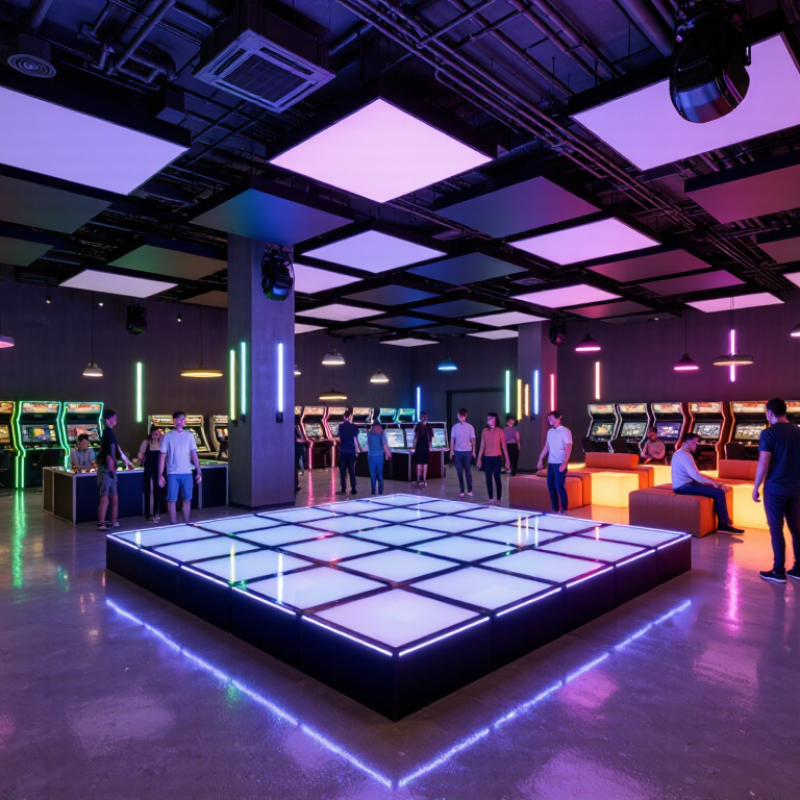
Entertainment centers usually combine several LED systems rather than relying on one fixture type. RGBW moving heads create saturated color and sharp beams on stage, while pixel-mapped strips outline seating, bars, and ceiling coves. Tunable-white downlights support quieter dining or arcade zones. High-bay fixtures suit large activity halls. DMX512 or network-based control links fixtures to scenes, dimming, and timed effects. Keep task lighting on separate control circuits; bright color looks vivid, but it can make menus and faces harder to read.
Efficiency needs careful interpretation. The U.S. Department of Energy’s 2022 Solid-State Lighting R&D Opportunities report describes leading LED package efficacy above 200 lumens per watt under controlled conditions. A complete fixture often delivers less after optics, drivers, and heat losses. That gap matters. Ask suppliers for luminaire-level test data, color consistency, flicker performance, and heat-management details—not just chip specifications. In a crowded room, poor aiming can send light into visitors’ eyes or create dark patches on the floor. One detail is often missed. A dramatic effect may need less output, not more. Test scenes in the actual space, with its ceiling height, reflective surfaces, and operating schedule. DOE report figures are useful benchmarks, but they do not predict a finished venue’s energy use.
China’s LED lighting industry serves entertainment venues with more than bright fixtures. Manufacturers and suppliers can provide moving lights, pixel bars, architectural strips, control systems, and power equipment. For a small event hall, compact fixtures may simplify rigging. A large venue may need coordinated zones, reliable data distribution, and service access above the stage. Practical experience matters: a lighting plan must work around sightlines, ceiling height, and the venue’s daily schedule.
Specifications deserve close attention. Ask for measured brightness, color consistency, dimming performance, and flicker test information suited to camera use. Check whether control protocols match the existing console, and confirm power requirements before installation. Heat management matters too. Fixtures running for hours in a warm booth can behave differently from units tested briefly in a showroom. Request sample testing under realistic conditions. On-site results can surprise you.
Supplier evaluation should include production quality checks, spare-parts availability, clear documentation, and response times for technical questions. Review sample units and inspect connectors, labels, and fixture movement—not just the product photos. Even a careful specification can miss the room’s atmosphere. I would leave time for a lighting rehearsal; color on a screen rarely tells the whole story.
Entertainment centers can source LED lighting from several supplier types, depending on the project. Specialist LED manufacturers typically offer fixtures, strips, drivers, and technical data for comparing brightness, color temperature, and power use. They may support custom lengths or control options, but buyers should confirm compatibility before ordering. A connector that looks right may still mismatch the controller.
Commercial lighting distributors carry ready-to-ship products from multiple manufacturers. This can simplify replacement and make comparing specifications easier. For programmed effects, such as color changes around a bowling lane or arcade entrance, an AV or lighting integrator may be more suitable. Integrators can coordinate fixtures, dimmers, and control systems. Their proposals should state installation needs and testing responsibilities clearly. A local electrical contractor can also assess wiring and mounting conditions, though not every contractor specializes in entertainment lighting.
Tips: Ask for a small sample and test it in the actual room. Check glare on screens, color consistency, heat, and dimming behavior. Request written specifications and warranty terms. A polished showroom display is useful, but it does not reproduce your ceiling height or ambient light. That detail is easy to overlook.
How to Evaluate Chinese LED Lighting Suppliers
For an entertainment center, evaluate lighting under real operating conditions, not only from catalog photos. Ask suppliers for photometric files, measured lumen output, color temperature, CRI, and dimming test results. Small details matter. A sample should run for hours in a warm enclosure, where heat can affect output and color. The U.S. Department of Energy’s Energy Saver guidance says LEDs use at least 75% less energy and can last up to 25 times longer than incandescent lighting. These figures are useful context, not a guarantee for every fixture or installation.
Request independent test documentation, including LM-79 reports for electrical and photometric performance, plus LM-80 data for LED package lumen maintenance. Check that report model numbers match the products being quoted. For an arcade or stage area, test flicker during dimming and record how colors appear on people, signs, and glossy surfaces. Ask for written details on warranty coverage, replacement parts, production lead times, and inspection procedures. Verify certificates with the issuing body where possible.
Then compare samples from the same batch, not just one hand-picked unit. Check connector fit, cable length, lens consistency, and whether the supplier can repeat the agreed specifications. I still treat a flawless sample cautiously. Production quality can vary, and a rushed inspection may miss it. Share a clear acceptance checklist before ordering, and arrange a pre-shipment inspection when the project scale justifies the cost.
Compare the ingress-protection digits stated in LED product specifications. These are IEC 60529 code digits—not supplier ratings or performance scores.
How to use this: The first IP digit describes protection against solid objects; the second describes protection against water. Ask suppliers for product-specific test reports and confirm the rating suits the installation environment.
When comparing LED lighting suppliers for an entertainment center, look beyond catalog brightness. Ask how they calculate coverage for a real room, including ceiling height, seating, reflective surfaces, and viewing angles. Request photometric files and a sample layout, then compare predicted hot spots with an on-site demonstration. A bright fixture can still create glare. Small details matter.
Check color consistency, dimming range, refresh behavior, and control compatibility under the venue’s actual operating conditions. Ask for test reports, warranty terms, replacement-part availability, and written response times. If possible, run a sample fixture through repeated dimming and color changes; record flicker on camera and note uneven transitions. Test it live. Assess engineering support, too: can the supplier explain power loads, heat management, installation tolerances, and maintenance access clearly? Look for evidence, not confident promises. Delivery capacity and batch quality checks deserve attention. One limitation is easy to miss: a successful sample may not represent later production. Specify acceptance checks before ordering, while allowing for adjustments once audiences use the space.
| Comparison Factor | Why It Matters for an Entertainment Center | Evidence to Request | How to Compare Suppliers |
|---|---|---|---|
| Photometric Performance | Beam angle, luminous output, uniformity, and glare control affect stage visibility, audience comfort, and the appearance of displays and architectural features. | Product datasheets, IES or LDT photometric files, and test reports identifying the tested configuration. | Compare products for the same application and mounting conditions. Check that the supplied photometric files correspond to the proposed fixture and optics. |
| Color Quality and Consistency | Color rendering and consistency are important for performers, themed spaces, food areas, and camera or video use. | Reported CRI and, where relevant, TM-30 data; binning information; and sample measurements from production batches. | Compare the same metrics and operating conditions. Ask how color bins are controlled across fixtures and replacement orders. |
| Dimming and Flicker Behavior | Low-level dimming and temporal light artifacts can affect visual comfort and may be visible in video recordings. | Dimming curves, control compatibility details, and flicker or temporal-light-artifact test data across the intended dimming range. | Test representative fixtures with the actual control system, especially at low dimming levels and with cameras used at the venue. |
| Control-System Compatibility | Entertainment venues may integrate lighting with show control, architectural controls, sensors, or building-management systems. | Supported protocol and interface documentation, wiring diagrams, configuration guidance, and interoperability test results. | Confirm compatibility with the project’s specified system. For example, DMX512-A and DALI are distinct control standards and are not interchangeable. |
| Electrical and Product Safety | Correct safety compliance supports safe installation and operation and helps meet destination-market requirements. | Test reports and certificates applicable to the exact product model, driver, and target market. Relevant standards may include IEC 60598 for luminaires and IEC 61347 for lamp-control gear, where applicable. | Verify the certificate scope, model numbers, issuing body, and validity. Requirements vary by market, product type, and installation. |
| Ingress Protection and Environment | Dust, humidity, cleaning practices, and outdoor exposure can affect service life in lobbies, attractions, kitchens, or exterior areas. | IP rating documentation, installation limitations, operating-temperature range, and environmental test reports where relevant. | Match the documented rating to the actual exposure. IP ratings are classified under IEC 60529; they do not by themselves establish suitability for every environment. |
| Thermal Design and Reliability | Heat management influences LED and driver operating conditions, light output maintenance, and the likelihood of premature failures. | Thermal test data, rated ambient-temperature conditions, component specifications, and clearly stated lifetime assumptions. | Compare like-for-like operating conditions and request the assumptions behind lifetime claims. Distinguish LED-source maintenance data from whole-fixture reliability claims. |
| Manufacturing and Quality Control | Consistent assembly and inspection help reduce variation between fixtures and minimize installation delays or replacements. | Documented incoming, in-process, and final inspection procedures; traceability records; and examples of corrective-action processes. | Ask how serial or batch traceability works and how defects are recorded, investigated, and prevented from recurring. |
| Customization and Project Engineering | Non-standard optics, finishes, mounting arrangements, or control settings may be needed for themed spaces and venue layouts. | Engineering drawings, a sample or prototype process, change-control records, and confirmation of which specifications can be customized. | Check that approved drawings and samples are tied to the final production specification, with revisions documented before manufacture. |
| Production Capacity and Lead-Time Planning | Large or phased projects require dependable production scheduling, delivery coordination, and consistent repeat orders. | Capacity and lead-time statements for the specific project, production milestones, and a documented plan for handling schedule changes. | Compare written schedules and assumptions, including sample approval, component availability, inspection, packaging, and shipment time. |
| Warranty, Spare Parts, and Support | Accessible technical assistance and replacement components can reduce disruption when fixtures need service. | Written warranty terms, exclusions, claim process, spare-parts policy, and technical-support response arrangements. | Compare coverage duration and conditions rather than duration alone. Confirm who handles claims and whether parts remain available for the project’s service period. |
| Documentation and Installation Support | Clear documentation helps electrical contractors install, configure, inspect, and maintain the lighting system correctly. | Installation and wiring instructions, product labels, configuration files, maintenance guidance, and project-specific schedules. | Review document completeness and consistency with the quoted models. Confirm that instructions are available in the language required by the project team. |